
Prevention · · 7 min read
How to measure blood pressure at home, step by step
A home blood pressure reading is only as useful as the way you take it. Wait at least 30 minutes after eating, drinking, smoking or exercise, sit with your back supported for 5 minutes, rest your arm at chest height, take at least two readings 1 to 2 minutes apart, and write every result down. Bring the log to your provider, who interprets it, and never change your medicine because of a number.
In short
- Wait at least 30 minutes after eating, drinking, smoking or exercise, empty your bladder, and sit with your back supported for at least 5 minutes.
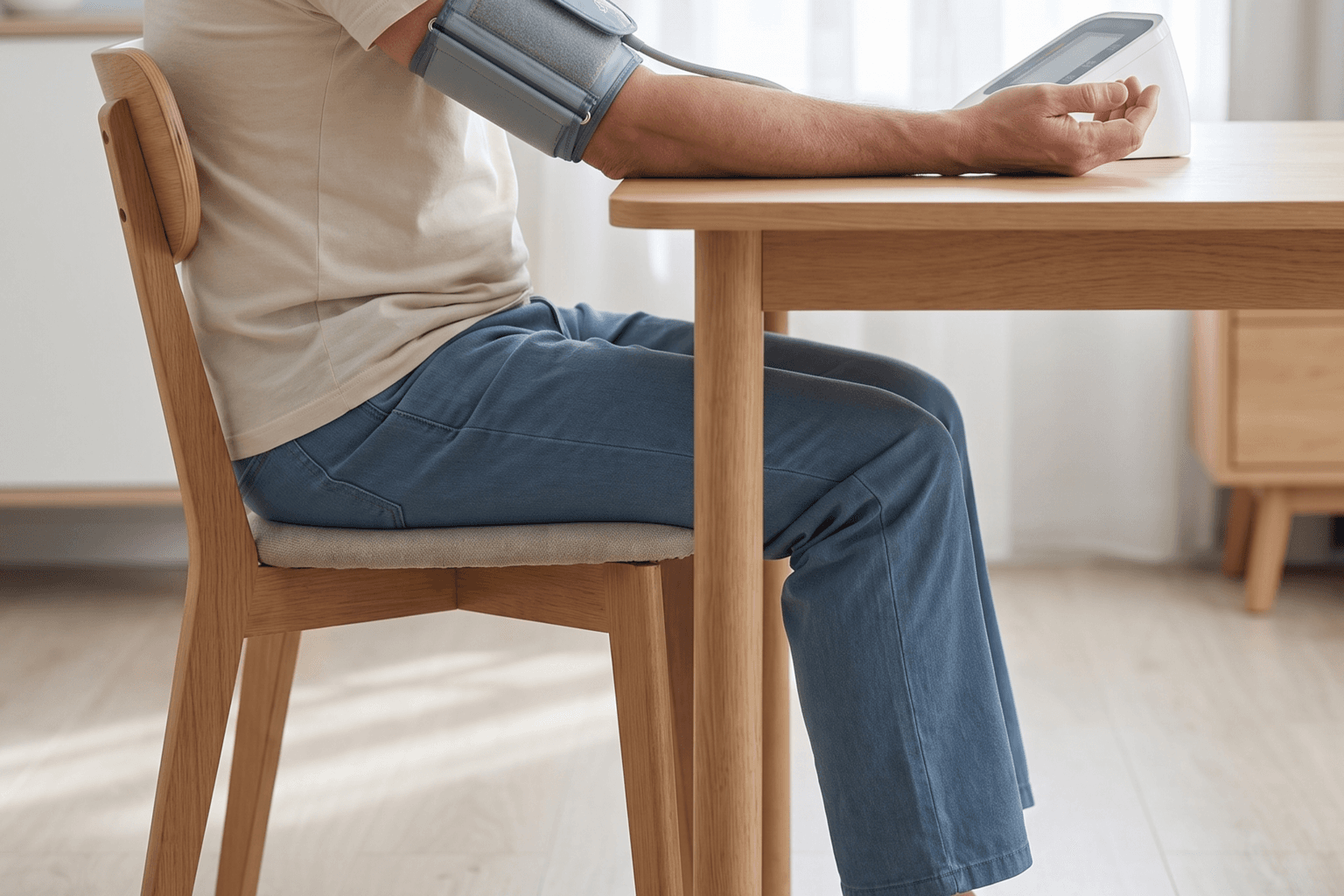
- Keep both feet flat with legs uncrossed, rest your arm on a table so the cuff is at chest height, and do not talk during the reading.
- Place the cuff snugly on your bare upper arm.
- Take at least two readings, 1 to 2 minutes apart, at the same time each day, and record them in a log.
- A single reading neither confirms nor rules out high blood pressure. Your provider interprets the pattern.
What the two numbers mean
The first number is the systolic pressure and the second is the diastolic pressure. Most people with hypertension have no symptoms, so the only way to know is to have your blood pressure measured, and the WHO stresses that a health professional's evaluation is still important even when you use an automated device at home.
Readings vary during the day. One result is a snapshot, not a diagnosis. Follow the instructions that come with your monitor, because models differ, and ask your doctor or nurse to show you how to use it correctly and how often to measure.
Preparation: the 30 minutes before
- Wait 30 minutesThe CDC says to wait at least 30 minutes after eating, drinking, smoking, drinking alcohol or caffeine, or exercising.
- Empty your bladderThen choose a quiet place and put your log and pen within reach.
- Sit for 5 minutesSit in a comfortable chair with your back supported for at least 5 minutes before you start.
- Check the monitorMake sure the batteries are charged and the cuff is the right fit for your arm.
Do not measure right after climbing stairs, a shower, an argument or coming in from the cold. If your provider gave you a different plan, for example because of pregnancy or a particular condition, follow that plan.
Body position
- Sit on a chair with a back, not the edge of a bed.
- Keep both feet flat on the floor and your legs uncrossed.
- Rest your arm on a table so the cuff is at chest height.
- Place the cuff on your bare upper arm so it fits snugly, not over a sleeve.
- Relax your hand and do not hold your phone or clench your fist.
- Do not talk or move while the monitor is working.
If a standard cuff does not fit your arm, do not force it. Ask your care team about another size. In a clinic the cuff goes around the upper arm.
The measurement, step by step
- Start the readingAfter 5 minutes of rest, press start and stay quiet.
- Write it downRecord both numbers, your pulse if the monitor shows it, the date and the time.
- WaitWait 1 to 2 minutes without getting up or talking.
- RepeatTake a second reading and record it separately.
- Keep to the scheduleMeasure at the same time each day for as many days as your provider advised.
The CDC advises at least two readings 1 to 2 minutes apart, and more often if you have high blood pressure. The NHS describes a common plan of one reading in the morning and one in the evening for a number of days chosen by your doctor or nurse. Do not pick only the best number or delete readings you do not like.
Keeping a useful log
A good line in your log has the date, the time, the first and second readings, and a short note on the circumstances, such as poor sleep, pain, a missed meal or stress. Write down the names of your medicines and when you actually took them. Do not skip a dose to see what the numbers do.
Show your provider the whole log and, if possible, the monitor itself. Patterns and averages are usually more informative than a lone high or low. If you miss a reading, note it and return to the schedule. Do not make up for it with extra checks. If the log makes you anxious, ask about a shorter schedule.
Why thresholds depend on context
Home and clinic readings are not judged identically. The NHS lists 135/85 as a high home reading and 140/90 in a clinic, and the WHO defines hypertension as 140/90 or higher confirmed on two different days. These are not contradictions, but a reminder that the setting and the series of readings matter.
Do not diagnose yourself from an online chart. Your own target may depend on age, pregnancy, diabetes, kidney disease and other risks. If a reading is different from your usual, check your technique and discuss any repeated trend with your provider. Many people need medicine even after lifestyle changes, so take what is prescribed and keep your appointments.
Common mistakes
- Cuff over clothing or a poor fit.
- Measuring straight after coffee, a cigarette, a meal or exercise.
- No support for the back or arm, crossed legs or hanging feet.
- Talking, watching the news or clenching a fist during the reading.
- Recording only one reading or only the lowest.
- Treating a normal reading as a reason to stop a medicine.
Red flags: do not wait
Red flags: call 911 for chest pain, trouble breathing, sudden weakness or numbness on one side, facial drooping, trouble speaking, seeing or walking, sudden severe headache, confusion or a seizure. Do not drive yourself, and do not spend time repeating measurements.
The WHO notes that very high readings, usually 180/120 or higher, can cause severe headaches, chest pain, dizziness, difficulty breathing, vision changes, confusion, nosebleeds or an irregular heartbeat. If you have a very high reading together with symptoms like these, seek care immediately. A very high reading without symptoms still calls for contacting your doctor or nurse for advice.
When to see your provider and what to ask
Book a routine visit if your readings are repeatedly higher than the range agreed with your provider, vary a lot from day to day, or your monitor often shows errors. Ask sooner if you are pregnant or have heart disease, kidney disease or diabetes.
- What range is the goal for me?
- At what times and for how many days should I measure?
- Which arm should I use, and does my cuff fit?
- Should I bring my monitor to compare with the office device?
- Which readings or symptoms mean I should call right away?
Questions and answers
Which arm should I use?
Your provider may compare both arms and tell you which to use. Use the same agreed arm for the log so results can be compared.
How many readings should I take at a time?
The CDC advises at least two, 1 to 2 minutes apart. Record both rather than choosing the lower one.
Can I stop my medicine if my readings are normal?
No. A normal reading may reflect your treatment working. Do not change a medicine, dose or timing without your provider.
Do I need a monitor that goes on the upper arm?
Clinics place the cuff around the upper arm, and the CDC steps describe an upper-arm cuff. Ask your provider which device suits you.
What if measuring makes me anxious?
Stick to the agreed schedule, prepare calmly and write everything down. If worry persists, ask your provider for a shorter monitoring plan.
Sources
Sources checked on 29 October 2026.