
First aid · · 7 min read
CPR steps: what to do if someone is not breathing
When someone collapses, does not respond and is not breathing normally, call 911 and start chest compressions right away. If you are untrained, hands-only CPR, pressing on the center of the chest at about 100 to 120 compressions a minute and about 2 inches deep for an adult, is recommended. Use an automated external defibrillator (AED) as soon as one arrives, and keep going until help takes over. This article is an overview and is no substitute for hands-on training.
In short
- If a person does not respond and is not breathing normally, call 911 and start compressions at once. Gasping or gurgling does not count as normal breathing.
- Press hard and fast on the center of the chest: about 100 to 120 compressions a minute, about 2 inches deep in an adult.
- If you are not trained, do hands-only CPR: compressions with no breaths.
- Use an AED as soon as it is available. It gives voice instructions.
- Do not stop until help arrives, the person breathes normally or someone takes over.
What CPR is and why speed matters
Cardiopulmonary resuscitation (CPR) is an emergency procedure for when someone's heart or breathing has stopped. Chest compressions keep oxygen-rich blood moving, and rescue breaths supply oxygen. It can follow events such as a heart attack, electric shock or drowning.
Time is short. Brain damage or death can occur within about 4 minutes if blood flow stops. According to NHLBI, nine out of ten people who have a cardiac arrest outside a hospital die, and about half of cardiac arrests happen in people who did not know they had a heart problem. A person who gets CPR and a shock from an AED sooner has a better chance, which is why bystanders matter.
Check first
- Check the sceneMake sure it is safe for you and the person.
- Check for a responseTap the shoulder and shout. Check for normal breathing. Gasping or gurgling does not count.
- Call 911 and send for an AEDIf someone is nearby, ask them to call while you start CPR, and ask another person to fetch an AED. If you are alone, call first, using speaker mode, then begin.
- Start compressionsLay the person flat on their back and begin right away, then keep going until help arrives.
How to do compressions on an adult
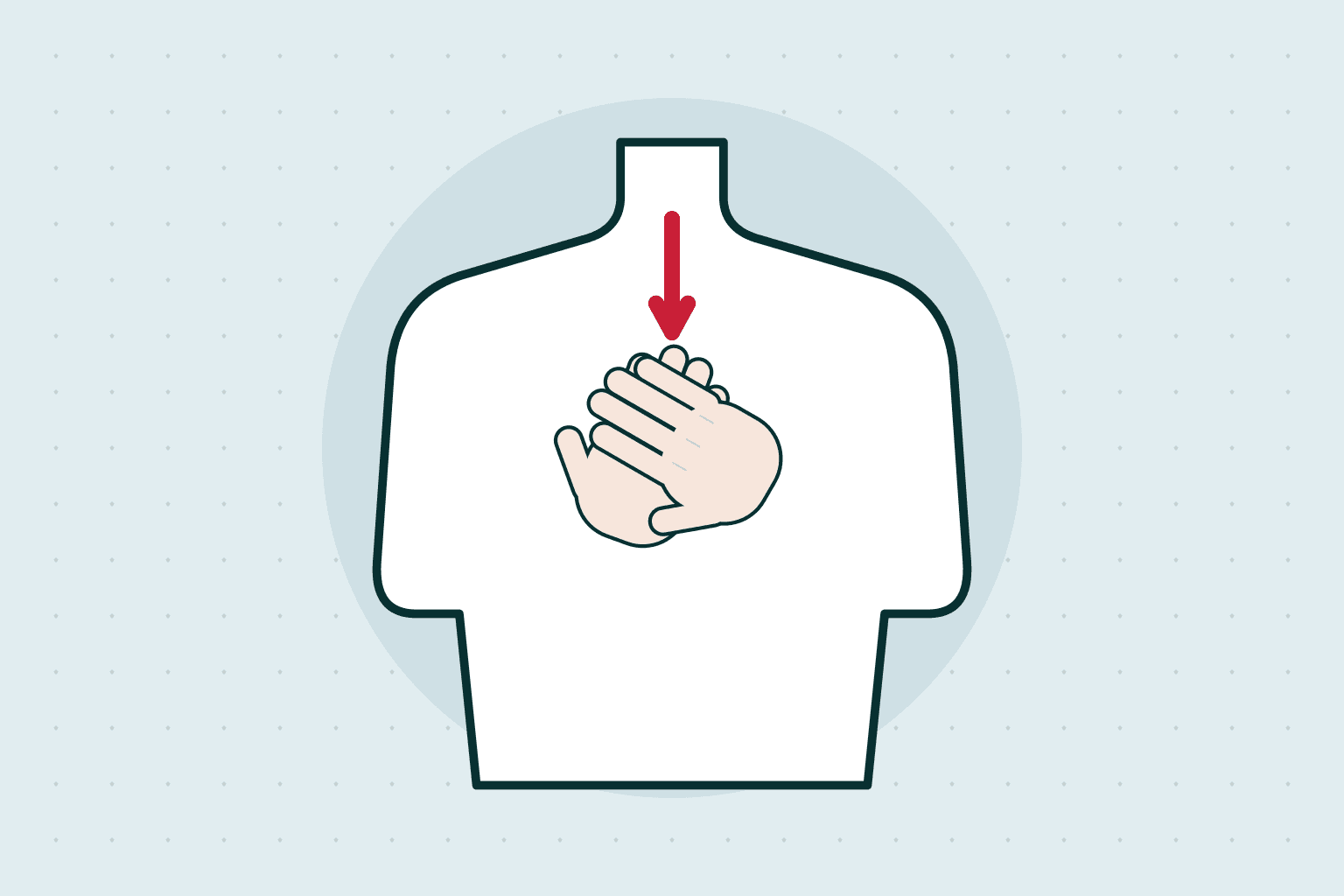
- Place the heel of one hand in the center of the chest and the other hand on top.
- Position your shoulders over your hands, with your elbows locked.
- Push down about 2 inches at a rate of about 100 to 120 per minute.
- Let the chest fully come back up between compressions.
- Keep going without long pauses until the AED gives an instruction, help arrives or the person breathes normally.
Hands-only CPR is for untrained rescuers, teens and adults: give chest compressions only, with no breaths, and continue until help arrives or the person breathes normally. If you are trained, add breaths. After every 30 compressions, tilt the head back, lift the chin, pinch the nose and give 2 breaths of about one second each, watching for the chest to rise.
Using an AED
An automated external defibrillator is a portable device that can deliver a shock to help restore a normal heart rhythm. They are found in many public places. AEDs are designed for untrained bystanders. Turn it on, follow its voice prompts, and resume CPR right after each shock.
Children, drowning and overdose
Children need both compressions and breaths, so hands-only CPR is not recommended for them. Compressions are about one-third the depth of the child's chest. Use child pads on an AED if you have them, and adult pads if you do not. Technique also varies for infants, so an infant CPR class is worth taking if you care for a baby.
If the cause may be an opioid overdose and you are trained to give naloxone, you can do so before first responders arrive, as NHLBI notes.
Common worries
- Worry about doing the wrong thing: if a person does not respond and is not breathing normally, they are in cardiac arrest. The sources say to call 911, start CPR and keep going until first responders arrive and take over.
- Worry about using the AED incorrectly: the device is built for untrained bystanders, speaks its instructions aloud, and you simply follow the prompts.
- Waiting for the ambulance without doing anything costs the minutes that matter most, because brain damage can begin within about 4 minutes without blood flow.
- Worry about forgetting the steps: the dispatcher on the 911 line can guide you through CPR, so stay on the phone.
When to call, and red flags
Call 911 first for sudden collapse and loss of consciousness, no response to shouting or shaking, no breathing, ineffective breathing or gasping. Calling first brings help sooner. The dispatcher can talk you through CPR.
Chest pain, pain spreading to the arm or jaw, sweating and breathlessness are warning signs of a heart attack, which can lead to cardiac arrest. Call 911 for those too, even if the person is still awake.
After and before
Stay with the person until help takes over. In hospital, teams monitor the heart, may use cooling to protect the brain, and look for the cause of the arrest, which can lead to treatments such as medicines or procedures to open arteries.
- Take an accredited course with practice on a manikin, such as those offered by hospitals, community organizations, the American Heart Association and the American Red Cross, and refresh it every two years.
- Find out where the AEDs are at work and near home.
- Teach teenagers in your family the basics.
Questions and answers
Do I have to give rescue breaths?
Not if you are untrained. Hands-only CPR is recommended for untrained rescuers who are helping a teen or adult. Breaths matter more for children and when you are trained.
How can I tell if breathing is abnormal?
Gasping or gurgling is not normal breathing. If the person does not respond and breathes like that, treat it as cardiac arrest and begin compressions.
Can I use an AED without training?
Yes. AEDs are designed for untrained bystanders and give spoken step-by-step instructions.
How long do I keep going?
Until emergency responders take over, the person starts breathing normally, or you cannot continue. Swap with another person if you can.
How often should I renew my training?
MedlinePlus advises refreshing an accredited CPR course every two years, since skills fade.
Sources
- MedlinePlus — CPR
- MedlinePlus — CPR (encyclopedia overview)
- NHLBI — Cardiac Arrest
- NHLBI — Cardiac Arrest: Treatment
Sources checked on 29 October 2026.