
First aid · · 7 min read
Tick bite: how to remove a tick and what to watch for
Most tick bites cause nothing worse than a small red spot, but some ticks carry infections such as Lyme disease. What you do in the first minutes matters: remove the tick promptly with tweezers, clean the skin, and then watch for a rash or fever over the following weeks. Do not wait for an appointment to take it off, and do not paint it with petroleum jelly or burn it.
In short
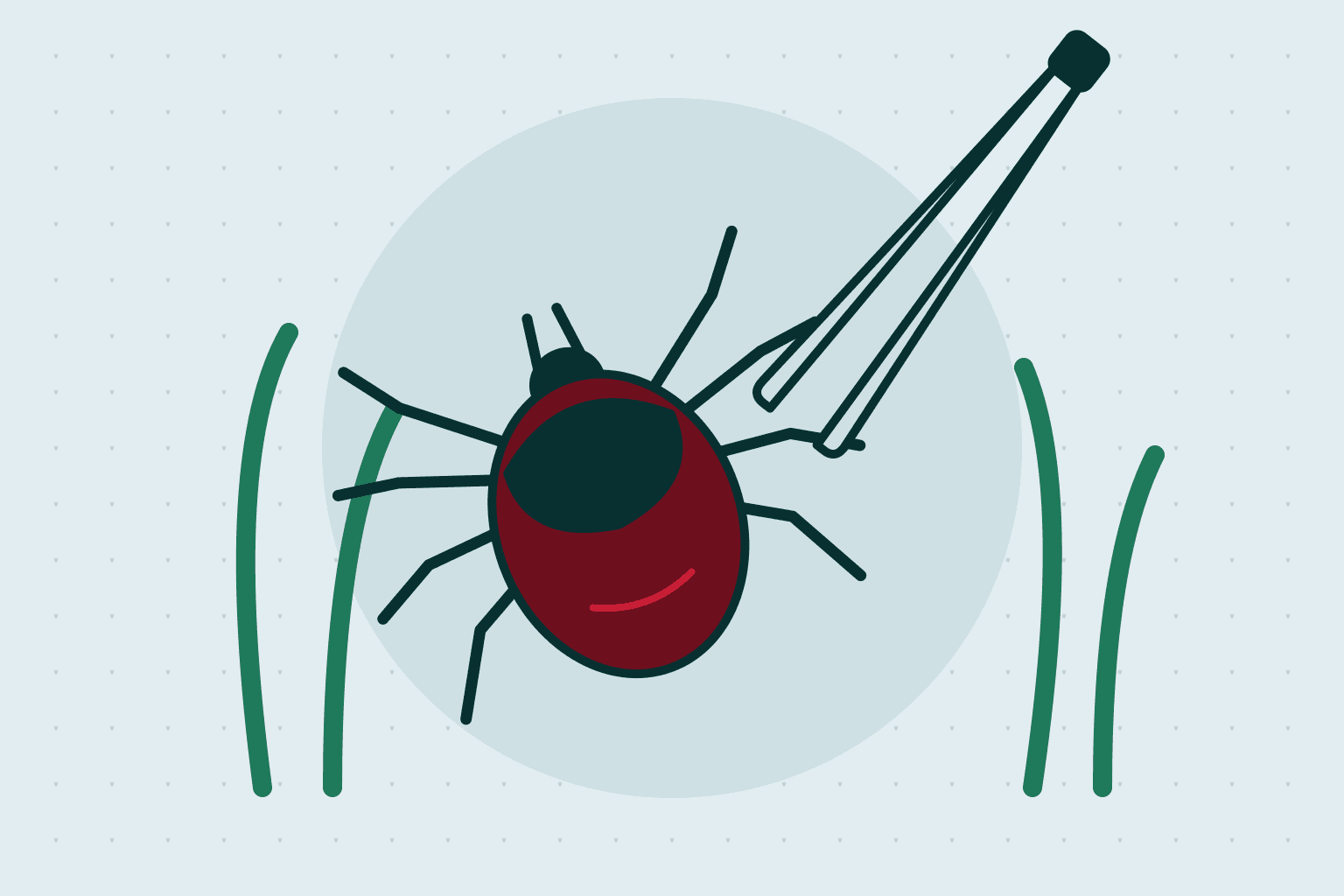
- Remove the tick right away with fine-tipped tweezers, pulling straight out with steady pressure at the skin.
- Skip petroleum jelly, heat or nail polish; they can make the tick release infected fluid into the skin.
- The CDC generally advises against having the tick tested, because results are not reliable enough to guide treatment.
- Watch for a rash or fever over the next several weeks, and tell your clinician about the bite if either appears.
- Prevention works: repellent, treated clothing, a tick check after being outside and a shower within two hours.
Why ticks matter
Ticks can carry germs that cause illness. The best known is Lyme disease, a bacterial infection, and another is tick-borne encephalitis, a viral infection of the nervous system. Not every tick is infected and not every bite leads to illness, but you cannot tell by looking at the tick.
Risk depends on where you live and travel. Ticks are most active from April through September, although you can be exposed at any time of year, and a bite can happen in your own backyard as easily as on a hiking trail.
How to remove a tick
- Do not wait.Take the tick off promptly rather than waiting for a healthcare provider.
- Grasp it close to the skin.Use fine-tipped tweezers and take hold of the tick as near to the skin as you can. Regular tweezers or fingers will do if that is all you have.
- Pull straight out.Use steady pressure. Do not twist or jerk, and do not squeeze the body.
- Deal with any mouthparts.If they stay in the skin, try to lift them out with tweezers. If they will not come out easily, leave them; the skin usually pushes them out as it heals.
- Clean the area.Wash the bite and your hands with soap and water, rubbing alcohol or hand sanitizer.
- Dispose of the tick.Seal it in a container, wrap it tightly in tape, drop it in alcohol or flush it. Do not crush it with your fingers.
- Check for more.Look over your whole body, since there may be other ticks attached.
Never use petroleum jelly, heat, nail polish or similar substances to try to make a tick back out. They can make it release infected fluid into your skin.
Should you test the tick?
In the United States, the CDC generally advises against sending a tick for testing. Laboratory results are not reliable enough to make treatment decisions, a positive result does not prove you are infected, and a negative result can be falsely reassuring. If you do become ill, treatment should begin without waiting for a tick test.
Symptoms to watch for
A small bump or patch of redness that appears right away and looks like a mosquito bite is common. It usually fades within one to two days and is not a sign of Lyme disease. What deserves attention is what shows up days to weeks later.
- Lyme disease, early: a rash called erythema migrans that starts at the bite site 3 to 30 days later, on average about 7 days. It expands gradually over several days, can reach 12 inches (30 cm) or more across, may feel warm, and is rarely itchy or painful. It appears in about 70 to 80 percent of infected people.
- Other early signs of Lyme disease: fever, chills, headache, fatigue, muscle and joint aches, and swollen lymph nodes, which can occur without a rash.
- Lyme disease, later: severe headaches and neck stiffness, more rashes, facial palsy, joint swelling especially in the knees, nerve pain, tingling, dizziness, or heart palpitations.
- Tick-borne encephalitis: usually within about a week, fever, tiredness, headache, muscle pain and nausea, sometimes followed by a second phase affecting the nervous system. Many infections have no symptoms.
When to see a doctor
Contact your primary care provider if you develop a rash, fever or any of the symptoms above after a tick bite, if you live in or recently traveled to an area where Lyme disease occurs, or if you are unsure. Tell them about the bite, when it happened and where you were likely bitten.
Red flags, call 911: a severe headache with a stiff neck and confusion, weakness, numbness or paralysis in the arms or legs, a drooping face, or a racing or irregular heartbeat with shortness of breath or fainting.
How it is treated
Most cases of Lyme disease are treated with 10 days to 4 weeks of antibiotics, as prescribed by a doctor. The choice depends on symptoms, age, allergies and pregnancy. People treated early with appropriate antibiotics usually recover rapidly and completely.
In certain circumstances, after a tick bite in an area where Lyme disease is common, a clinician may offer a one-time preventive antibiotic. Whether that is right for you is a question for a healthcare provider, so do not take leftover antibiotics on your own. Tick-borne encephalitis has no specific antiviral treatment; severe cases need hospital care and supportive treatment.
Preventing tick bites
- Use repellent.Choose an EPA-registered product with an ingredient such as DEET or picaridin. Apply sunscreen first, then repellent. Some products are not for children under 3.
- Treat clothing.Boots, clothing and gear can be treated with permethrin, or you can buy pre-treated items.
- Stay on the trail.Avoid brushy areas with high grass and leaf litter, and walk in the center of trails.
- Do a tick check.After time outdoors, check your whole body, using a mirror: under the arms, in and around the ears and hair, the belly button, behind the knees, between the legs and around the waist.
- Shower and dry.Showering within two hours of coming indoors reduces the risk of Lyme disease. Tumble dry clothes on high heat for 10 minutes to kill ticks.
- Check pets and gear.Ticks can hitch a ride indoors on pets, coats and daypacks.
In places where tick-borne encephalitis occurs, vaccination is one of the most effective ways to prevent it. Avoiding unpasteurized dairy products also lowers the risk.
Questions and answers
Do I need to see a doctor if I removed the tick myself?
Not necessarily. If you removed it promptly and feel well, watch the bite site and your health over the next several weeks. See a clinician if a rash, fever or other symptoms appear.
What if part of the tick stays in my skin?
Try to remove the pieces with clean tweezers. If they do not come out easily, leave them alone and keep the area clean, because the skin usually pushes them out as it heals.
Does a rash always appear with Lyme disease?
No. The expanding rash appears in roughly 70 to 80 percent of infected people, and fever, chills, aches and fatigue can happen without it. That is why you should watch your overall health after a bite, not only the skin.
Does everyone bitten need preventive antibiotics?
No. The CDC says a one-time preventive antibiotic may lower infection risk only in certain circumstances, after a bite in an area where Lyme disease is common. A clinician decides whether you fit those circumstances.
How can I kill ticks on my clothes?
Put dry clothes in the dryer on high heat for 10 minutes. Damp clothes may need longer, and if you wash first, use hot water, since cold and medium water will not kill ticks.
Sources
- CDC — What to Do After a Tick Bite
- CDC — Signs and Symptoms of Lyme Disease
- CDC — Lyme Disease Treatment
- CDC — Preventing Tick Bites
- ECDC — Tick-borne encephalitis
Sources checked on 29 October 2026.